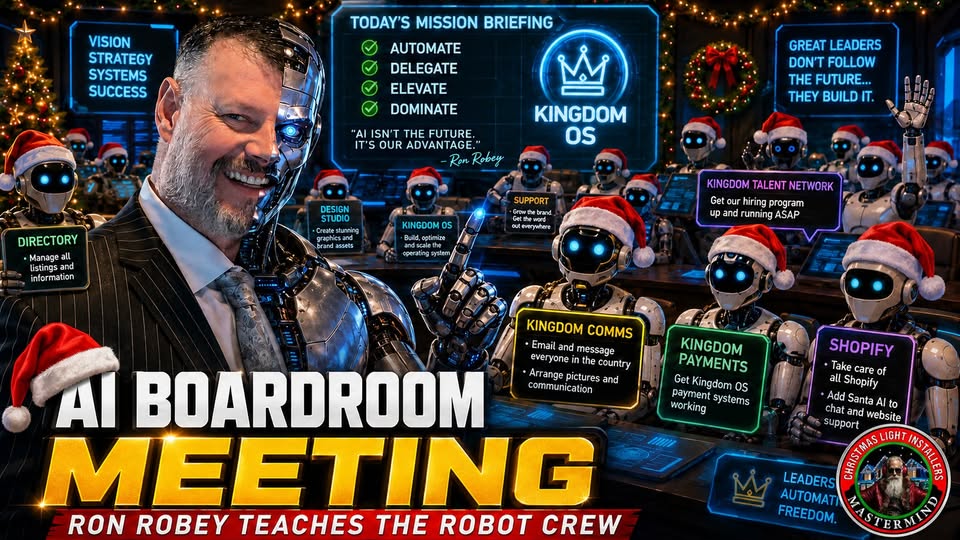
AI Is Becoming a Real Business Tool for Christmas Light Contractors
Artificial intelligence is moving quickly from something people talk about into something business owners can actually use every day. For a Christmas light installation company, that matters because our season is compressed. Leads come in fast, estimates need to move, customers expect communication, crews need direction, inventory has to be ready, marketing has to stay active, and small mistakes can become expensive when the calendar is full.
That is where AI can create leverage. The goal is not to hand your company over to a robot. The goal is to use technology to help you think faster, communicate more consistently, organize information, reduce repetitive work, and give your people better direction.
A Christmas light contractor who learns how to use AI well can potentially accomplish more with the same number of hours. But the advantage will not come from simply having access to an AI tool. The advantage comes from connecting AI to a good process, good information, good products, and good leadership.
Where Can AI Help a Christmas Light Business Today?
There are dozens of possible use cases, but the best place to start is with the work that already consumes your time or creates bottlenecks in your company.
1. Customer Communication and Lead Follow-Up
Speed matters when a homeowner reaches out about Christmas light installation. A lead who is excited today can be cold tomorrow. AI can help draft responses to common questions, organize follow-up messages, summarize conversations, prepare appointment notes, and create consistent explanations of your services.
That does not mean every customer should receive the same robotic answer. Your company still needs personality and judgment. AI should help your team respond faster while keeping the communication accurate, professional, and aligned with your brand.
A useful system might take a lead's notes and help your salesperson produce a clear next-step message: what the customer asked for, what information is still needed, what happens next, and when they should expect an estimate.
2. Estimates, Proposals, and Sales Presentations
AI can also support the estimating process. It can help organize measurements, turn job notes into a cleaner proposal description, explain options in plain language, and prepare follow-up messages after an estimate is sent.
The key word is support. Pricing, measurements, material quantities, electrical planning, installation feasibility, and final job scope still need human verification. AI can make the paperwork and communication faster, but the contractor remains responsible for the job.
If your estimating system already has clear packages, pricing rules, photos, and service standards, AI becomes much more useful because it has a process to work with. If the business has no defined sales process, AI can make confusion move faster too.
3. Marketing, Social Media, Blogging, and SEO
This is one of the easiest places for contractors to begin. A single field photo, customer question, training lesson, or Mastermind conversation can become a social media post, an email, a blog article, a video outline, a FAQ, and several follow-up ideas.
For a seasonal business, consistent content can help a company stay visible before the buying season, during peak season, and after installations are complete. AI can help turn the knowledge already inside your company into useful content instead of letting that knowledge disappear at the end of every workday.
That content still needs real experience behind it. Search engines and customers do not need another thousand generic articles that say the same thing. The strongest content comes from combining AI with actual field experience, actual customer questions, actual installation knowledge, and a clear point of view.
4. Hiring, Onboarding, and Employee Training
Seasonal hiring creates another major opportunity. Christmas light businesses often need to recruit and train quickly without lowering standards. AI can help turn your best practices into onboarding checklists, training quizzes, role expectations, safety reminders, job descriptions, crew-leader notes, and bilingual training support.
Think about how much knowledge lives only in the owner's head. How should a roofline be laid out? How should a customer be greeted? What does a clean install look like? What mistakes should a new installer avoid? What does the crew do before leaving a property?
The more of that knowledge you document, the easier it becomes to train people consistently. AI can help organize and polish that knowledge, while experienced leaders verify that the instructions are correct.
Contractors who want hands-on installation and business development can also explore our Personal VIP In-Person Christmas Light Installation Training & Advanced Business Mastermind.
5. Scheduling, Project Management, and Crew Direction
A busy installation season creates hundreds of small decisions. Which job goes first? Which crew has the right skills? Which material is needed? Which customer needs a callback? Which job is waiting on approval? Which property has a service issue?
AI can help summarize job information, create daily briefings, organize priorities, identify missing information, and turn scattered notes into clearer crew instructions. The better your underlying data is, the better those summaries become.
This is where AI starts becoming more than a writing tool. It can become an operating assistant that helps leadership see what needs attention.
6. Website Support and Automated Customer Questions
A contractor website can answer more questions before a salesperson ever picks up the phone. AI-assisted website support can help explain services, guide customers toward the right next step, collect project information, and answer common questions after hours.
But a website assistant needs guardrails. It should know what your company actually sells, where you actually work, what your policies are, and when it should stop answering and hand the conversation to a human. An AI that confidently invents an answer is worse than no answer at all.
The goal is not to make customers feel like they are trapped in automation. The goal is to make it easier for them to get useful information and move toward a real solution.
7. Inventory, Purchasing, and Business Reporting
AI becomes especially powerful when it can help organize operational information. A Christmas light company may be tracking bulbs, wire, clips, plugs, timers, greenery, mini lights, permanent lighting components, tools, and job-specific materials at the same time.
AI can help summarize purchasing needs, flag unusual usage, compare planned material against available stock, organize vendor information, and turn reports into plain-English explanations for the owner.
But again, the quality of the answer depends on the quality of the data. If inventory is inaccurate, AI cannot magically make it accurate. The foundation still matters.
For contractors who already know what they need, our Quick Order page is designed to make purchasing faster. Products such as SPT-1 Zip Cord and the Dynamic RGBWW Transparent Faceted C9 Bulb are examples of the kind of catalog information that becomes more useful when inventory, purchasing, and job planning are connected.
8. Christmas Light Design Concepts and Renderings
Design is another area changing quickly. AI can help generate concepts, organize inspiration, explain lighting options, and support the creation of visual presentations that make it easier for customers to understand what they are buying.
For contractors, the real opportunity is not just making a pretty picture. The opportunity is connecting design to an installable scope: roofline footage, tree treatment, colors, product type, attachment method, labor, material, and price.
A design that cannot be installed profitably is not a business system. AI becomes valuable when it helps bridge the gap between the customer's imagination and a real project your crew can deliver.
AI Should Multiply Leadership, Not Replace It
There is a temptation to think the future belongs to whoever automates the most. That is incomplete.
The future belongs to the companies that combine strong leadership with better tools. AI can draft. It can summarize. It can organize. It can compare. It can suggest. It can automate parts of a workflow. But the business owner still decides what the company stands for, what quality looks like, who gets hired, what promises are made to customers, and what standards are acceptable.
We have talked before about the difference between experience and information in Street Smart vs. Book Smart: What Matters Most for Contractors in the AI Era?. AI makes information easier to access. That makes real-world judgment, leadership, and experience even more important—not less.
A Simple Way to Start Using AI in Your Christmas Light Company
You do not need to automate the entire business on day one. Start with one repeated problem that costs time every week.
- Choose one bottleneck. Lead follow-up, estimate descriptions, crew notes, content creation, hiring, inventory review, or customer FAQs are good examples.
- Define the correct process first. Write down what a good result actually looks like before asking AI to help.
- Give the AI real context. Your services, policies, products, tone, pricing rules, training standards, and examples matter.
- Keep a human review step. Verify customer promises, pricing, measurements, safety information, legal or payroll matters, and anything that could materially affect a job.
- Measure the result. Did response time improve? Did the estimate go out faster? Did the crew ask fewer questions? Did the content produce leads? Did the owner save time?
- Automate only after the process works. Do not automate confusion. Prove the workflow first, then make it faster.
Protect the Business While You Use AI
AI is powerful, but contractors should still use common sense. Do not casually paste passwords, payment-card information, private employee records, or sensitive customer information into tools without understanding how that information is handled. Use appropriate permissions, keep human approval on high-impact decisions, and make sure your team knows which information should and should not be shared.
AI should increase the professionalism of the business—not create a new source of risk.
Question of the Day: How Are You Using AI?
Now bring it back to your company.
How are you currently using AI in your Christmas light business?
Are you using it for customer communication and lead follow-up? Estimates and sales presentations? Marketing content? Hiring and onboarding? Scheduling? Website support? Inventory? Reporting? Design concepts?
And the bigger question:
What jobs, systems, or responsibilities do you want AI helping manage tomorrow?
The companies that get the biggest advantage from AI will not necessarily be the companies with the fanciest software. They will be the companies that know what they are trying to accomplish, build good systems, feed those systems good information, and keep improving them.
Use AI to move faster. Use it to get organized. Use it to communicate better. Use it to train better. Use it to see your business more clearly.
Then keep doing the part technology cannot do for you: lead.
#GetBusy