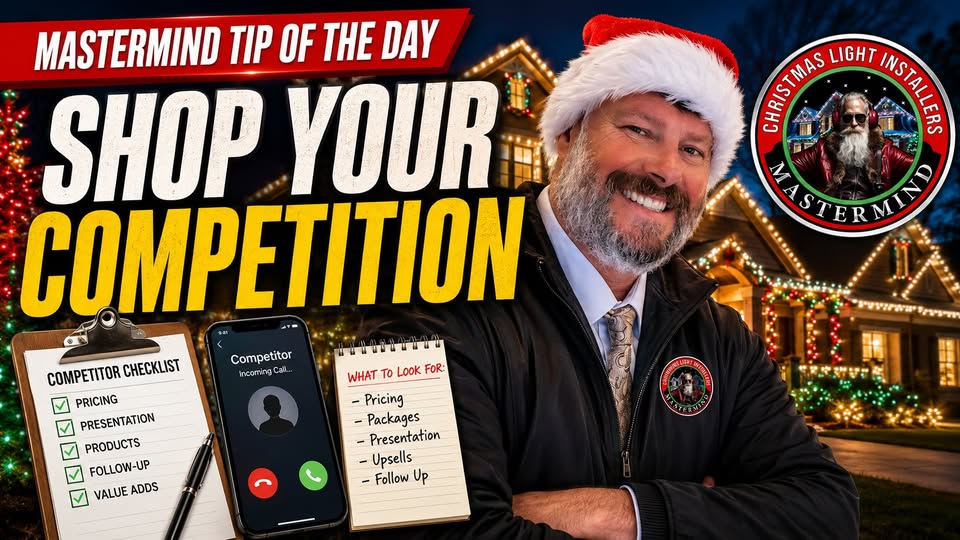
If your clients are shopping around, you need to know what they are seeing.
That is especially true in the Christmas light installation business, where a homeowner may talk to three, four, or five companies before deciding who gets the job. They are comparing more than price. They are comparing how quickly you answer, how confident you sound, how professional your estimate looks, what products you use, what is included, how the installation process works, what happens after Christmas, and whether they trust you to do what you said you would do.
That is why one of the smartest things a Christmas light contractor can do is shop the competition.
Not to copy them. Not to obsess over them. Not to race them to the bottom on price.
Do it so you understand the customer experience you are being compared against—and so you can deliberately build a better one.
Your Customer Is Already Comparing Christmas Light Companies
When a homeowner searches for Christmas light installation, asks friends for recommendations, clicks through Google results, or fills out multiple estimate forms, they are building a mental scorecard.
They may never tell you what is on that scorecard, but they are noticing things like:
- Who answered the phone first?
- Who sounded organized?
- Who asked the best questions?
- Who sent the estimate fastest?
- Whose proposal was easiest to understand?
- Who explained products and service clearly?
- Who had the strongest photos and reviews?
- Who created confidence instead of confusion?
- Who followed up professionally?
- Who made it easiest to say yes?
If you do not know what your competitors are offering, you are trying to improve your sales process without seeing the full playing field.
Do They Answer the Phone?
Start with the simplest question.
What happens when a potential customer contacts them?
Do they answer immediately? Does the call go to voicemail? Is the voicemail professional? Do they call back in five minutes, five hours, or two days? Do they text? Do they send an automated response? Does the customer know what happens next?
In a seasonal business, speed matters because excitement has a shelf life. A homeowner may be highly motivated when they first call. Every hour of silence gives them more time to talk to somebody else.
This does not mean you have to personally answer every call. It means your lead response system needs to feel intentional. Your customer should never be wondering whether their inquiry disappeared into a black hole.
How Strong Is the Sales Conversation?
When someone does answer, listen to the structure of the conversation.
Do they immediately throw out a price, or do they learn about the property and what the customer actually wants? Do they ask about roofline lighting, trees, wreaths, garland, columns, driveway lighting, permanent lighting, or commercial displays? Do they explain the difference between basic and premium options?
The best sales conversations help the customer make a decision. They do not just collect an address.
This is an area where professional training can create a major advantage. Our Personal VIP In-Person Christmas Light Installation Training & Advanced Business Mastermind is designed for contractors who want to improve not only installation skills, but the business systems and decision-making around the work.
How Fast Do They Produce a Christmas Light Estimate?
One of the biggest competitive advantages in this industry is the ability to create an accurate, detailed Christmas light estimate while the lead is still hot.
Shop the competition and find out what their quoting process feels like from the customer's side.
- Do they give a rough price over the phone?
- Do they require an on-site appointment?
- How long does it take to receive a written proposal?
- Does the quote include photos or visual references?
- Are the service options clearly separated?
- Can the customer understand exactly what is included?
- Do they explain payment terms?
- Do they explain removal, storage, warranty, and future-season pricing?
A fast quote is powerful only when it is also professional. Speed without clarity creates mistakes. Clarity without speed can lose the sale. The goal is both.
Compare the Proposal, Not Just the Price
This is where many contractors make a mistake. They shop a competitor, hear a lower price, and immediately think they need to lower theirs.
That is the wrong comparison.
You need to compare the entire offer.
A $2,000 proposal and a $3,000 proposal may not be competing products at all if one includes commercial-grade materials, service calls, professional removal, storage, timers, better installation practices, stronger warranty support, and a more complete design.
Ask:
- What exact areas of the property are included?
- What bulb style and spacing are they using?
- What clips and attachment methods are included?
- Are materials leased, sold, or included as part of the service?
- Who owns the lights after the season?
- Is removal included?
- Is storage included?
- How are service calls handled?
- What happens next season?
That information tells you far more than a single price number.
Your Product Story Is Part of Your Sales Story
Customers may not know the technical differences between professional Christmas light products, but your presentation should still make it clear that your company has standards.
For example, a contractor who can confidently explain why they use commercial-grade roofline components has a stronger story than someone who simply says, “We put lights on the house.”
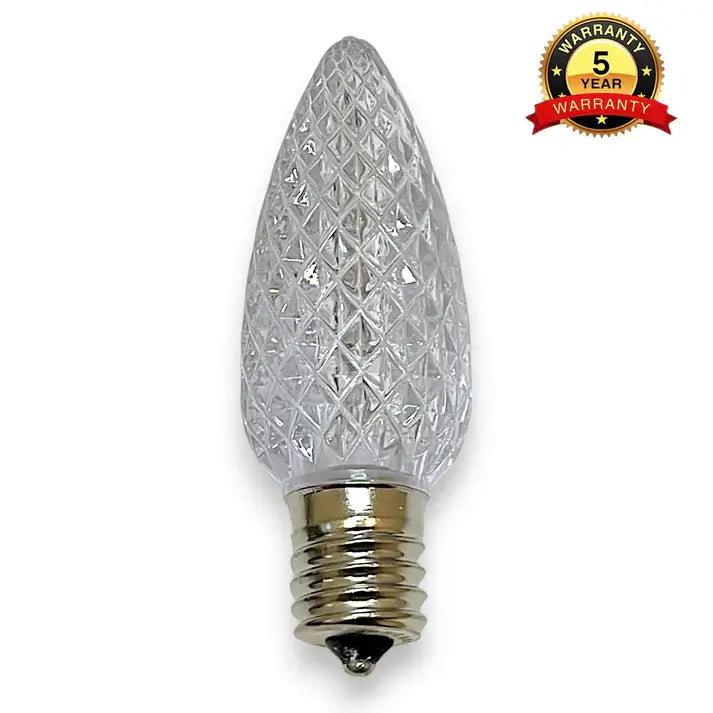
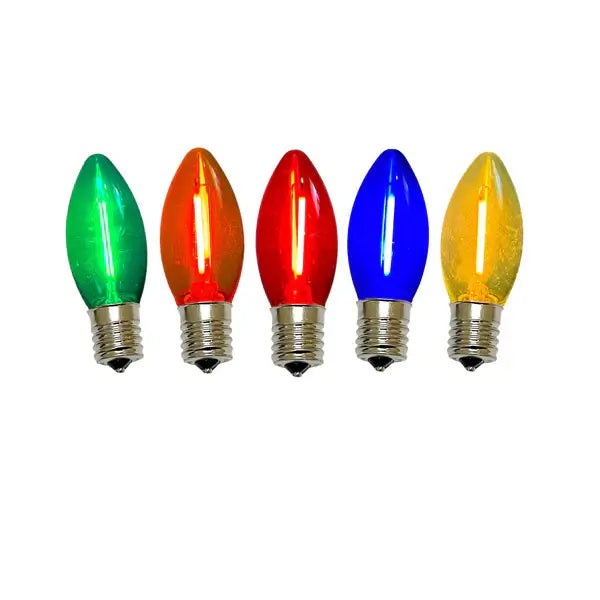
That is why operational consistency matters. Products such as C9 Commercial Elite SMD LED Christmas Light Bulbs, SPT-1 Zip Cord, and the C9 Best Clip can become part of a repeatable professional system instead of every crew improvising from whatever happens to be in the truck.
Your sales promise and your field execution need to match.
What Does Their Presentation Look Like?
Presentation affects perceived value.
Look at the competitor's website, estimate, photos, uniforms, trucks, emails, text messages, and sales materials. Does the company look established? Does everything feel connected, or does it feel improvised?
Pay attention to whether they offer:
- Good project photography
- Before-and-after examples
- Multiple design options
- Packages or clearly defined service levels
- Upsell opportunities such as trees, greenery, wreaths, or permanent lighting
- Professional payment and scheduling instructions
- Clear next steps after the estimate
You are not looking for something to steal. You are looking for the standard your market is setting—and the gaps your company can own.
Study the Follow-Up Process
A lot of Christmas light companies lose jobs after doing the hard part.
They answer the lead. They measure the property. They build the estimate. They send the proposal.
Then nothing.
No follow-up. No reminder. No helpful answer. No urgency. No explanation of schedule availability.
If your competition has a disciplined follow-up system and you do not, that alone can explain why they close more work.
Shop the competition to understand:
- How quickly they follow up after the quote
- Whether they use text, phone, or email
- How many times they follow up
- Whether they answer objections proactively
- Whether they create real urgency around the installation calendar
- Whether they make booking easy
Then tighten your own process.
Look at the Entire Customer Journey
Competitive research should go beyond the initial sale. Think through the full Christmas light installation customer journey.
What happens after the customer books? Are reminders sent? Does the customer know what day the crew is coming? Is the crew uniformed and prepared? Is the property treated professionally? Is there a walkthrough after installation? How are service calls requested? What happens at removal? How is next season handled?
The strongest company is not necessarily the one with the cheapest quote. It is often the one that removes the most uncertainty.
A Simple Competitor Scorecard
Use a consistent scorecard so you are comparing companies objectively instead of relying on impressions.
| Category | What to Evaluate |
|---|---|
| Lead Response | Answer speed, professionalism, callback process |
| Sales Conversation | Questions, confidence, education, upsells |
| Estimate | Speed, detail, clarity, design presentation |
| Pricing | Total price compared with actual scope and inclusions |
| Products | Bulbs, wire, clips, greenery, permanent lighting options |
| Service Model | Lease vs. sale, warranty, removal, storage |
| Follow-Up | Frequency, professionalism, urgency, objection handling |
| Branding | Website, photos, reviews, uniforms, vehicles, materials |
| Booking | How easy it is to approve, pay, and schedule |
| After-Sale | Communication, service calls, removal, next-season retention |
Do Not Copy the Competition—Find the Gap
The point of competitor research is not to become a slightly different version of somebody else.
The point is to ask:
Where is the market weak, and where can we become undeniably better?
If every competitor takes two days to send an estimate, build a ten-minute estimate process.
If every competitor sends a confusing one-line price, create a professional visual proposal.
If everybody talks only about rooflines, become better at presenting complete-property designs.
If everyone struggles with follow-up, build a disciplined follow-up system.
If competitors are disorganized with materials, standardize your crews and use a repeatable ordering process. The ChristmasContractor.com Quick Order page is built to help contractors move through common supply purchasing faster instead of hunting across the store one item at a time.
Competitive Research Should Make Your Business More Professional
You do not need to become deceptive or weird about this. A lot of useful competitor intelligence is public. Study websites, ads, social media, reviews, service pages, published pricing, customer comments, and the proposals your real prospects voluntarily share with you. You can also experience normal sales channels when appropriate, while respecting privacy, contracts, and applicable laws.
The goal is not espionage.
The goal is awareness.
You need to know what your customers are comparing you against so you can make better decisions about your own:
- Pricing
- Packages
- Presentation
- Products
- Sales scripts
- Follow-up
- Scheduling
- Warranty
- Removal and storage
- Customer experience
The Mastermind Challenge
Pick three legitimate competitors in your market and evaluate them this week.
Do not start by asking, “How cheap are they?”
Start by asking:
What does the customer experience from the first click to the final decision—and where can we make ours better?
Then choose the three biggest gaps in your own process and fix them.
Better phone experience.
Better presentation.
Better quote.
Better options.
Better follow-up.
Better value.
Shop your competition. Then tighten your process and make your company the obvious choice.
If you want to sharpen both the field side and the business side of your Christmas light company, explore our Christmas Light Installation Training & Advanced Business Mastermind and the contractor products and ordering tools available at ChristmasContractor.com.